It doesn’t just sit beside the Salar de Uyuni, it is actually made from it. More than a million blocks of salt were cut from the flats themselves and used to build the walls, ceilings, pillars and even some of the furniture inside. When they committed to the salt theme, they really committed.
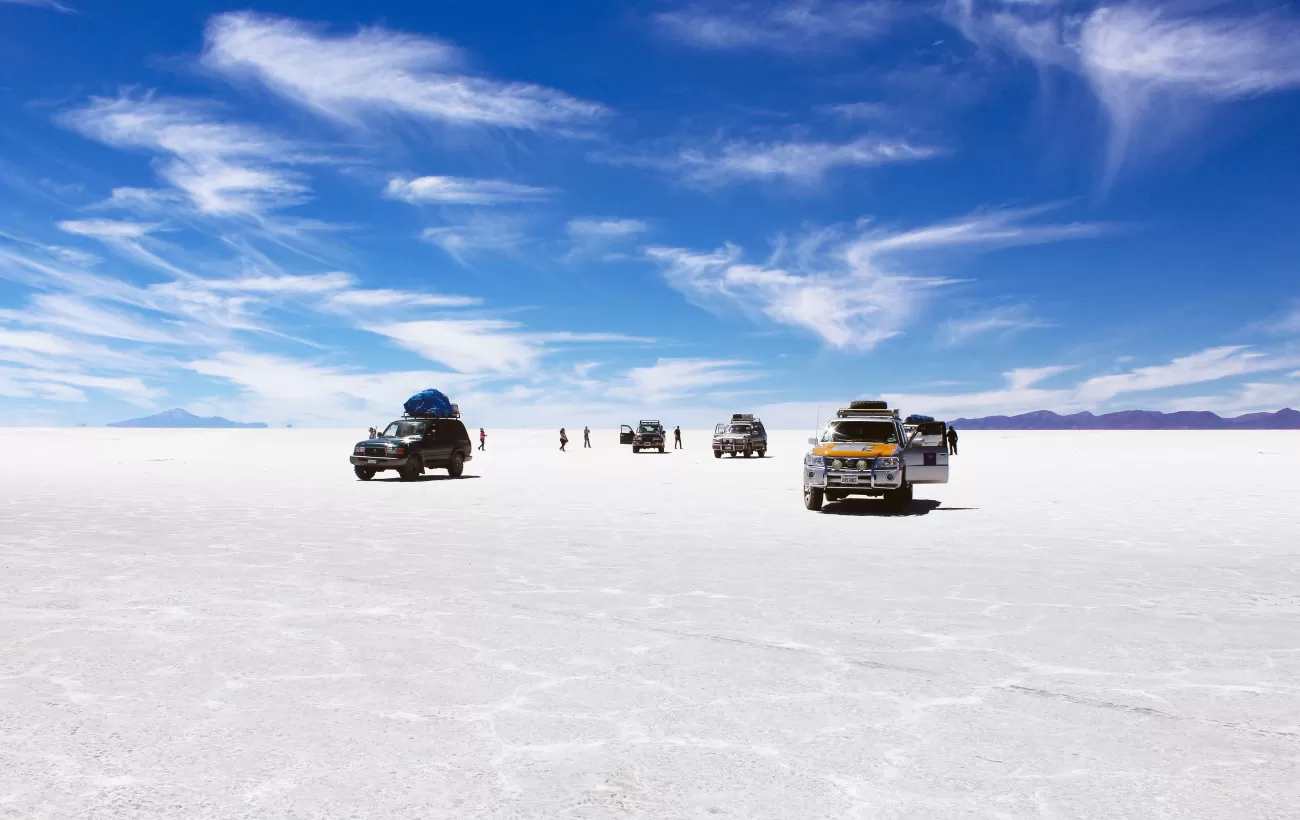
The hotel sits on the edge of the Salar de Uyuni, the largest salt flat in the world, stretching across almost 12,000 square kilometres at more than 3,700 metres above sea level. It is one of those places that looks impressive in photos but makes far more sense once you are standing in the middle of it. There is almost nothing around you to judge distance against. Just white salt, enormous skies and a horizon that seems to keep going no matter how far you drive.
During the rainy season, a thin layer of water can sit across the surface and turn the entire Salar into a giant mirror. The sky reflects underneath you so clearly that, in the right conditions, it becomes almost impossible to work out where the ground ends. It is one of those landscapes that manages to look slightly ridiculous and completely beautiful at the same time.
Built from the landscape around it
Palacio de Sal was first created in the late 1990s from the fairly ambitious idea of building a hotel almost entirely from salt.
The blocks are held together using a mixture of ground salt and water, and the result is much more impressive than the words “salt hotel” probably suggest. Curved corridors run beneath domed ceilings, the walls have this beautiful textured finish, and salt sculptures and furniture are worked throughout the property. It doesn’t feel like someone has taken a normal hotel and added a few salt lamps for effect. The entire building genuinely comes from the landscape around it.
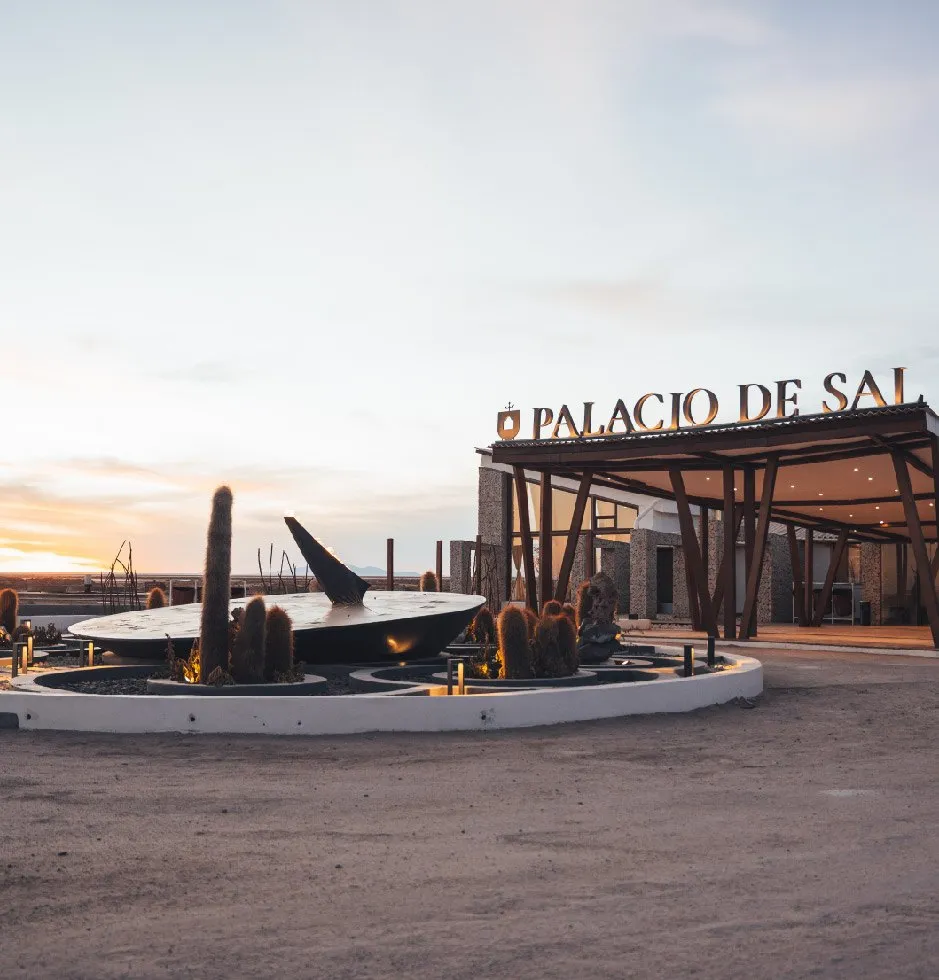
Of course, there is one fairly obvious problem with building a hotel from salt.
Rain.
Each year, around 10 per cent of the structure needs to be restored as moisture gradually affects the salt blocks. Local craftspeople rebuild those areas using fresh salt from the Salar, and rather than pretending this doesn’t happen, the hotel has simply made it part of its story. There is even a section that has deliberately been left untouched so you can see exactly what time and weather do to the building.
There is something refreshingly honest about a hotel admitting that part of it slowly dissolves every year.
Salar de Uyuni, Bolivia
We quite like that. There is something refreshingly honest about a hotel admitting that part of it slowly dissolves every year.
The original Palacio de Sal was actually built on the salt flat itself before being moved to its current position on the edge of the Salar. Today, the hotel covers more than 4,500 square metres and sits around 25 kilometres from the town of Uyuni, close enough to properly feel part of the landscape without literally sitting on top of it.
So what is it actually like to stay there?
This is probably the part where you start wondering whether staying in a hotel made from salt is actually comfortable.
Thankfully, yes.
You walk through curved salt-block corridors and beneath those distinctive domed ceilings before reaching rooms where even the bed bases can be made from salt. Thankfully, the mattress is not.
The rooms are warm and comfortable, with central heating, electric blankets, private bathrooms and all the normal comforts you want after a day outside on the Bolivian Altiplano. At more than 3,700 metres above sea level, this is not somewhere you want to discover your room is a little draughty.
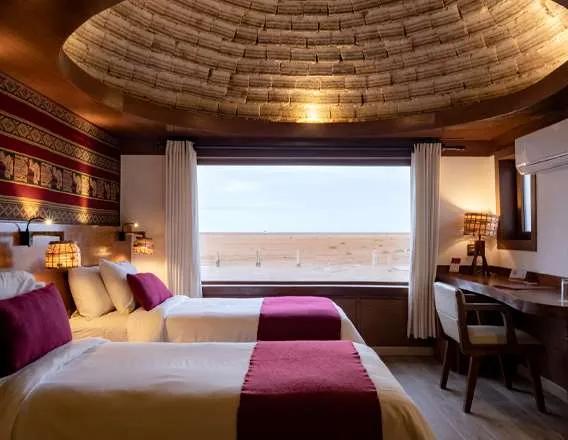
Some room categories look directly towards the Salar, while the Hanan Suites have larger windows, a separate living area and those beautiful domed salt ceilings overhead. The design is simple, but that really works here. You haven’t travelled all this way for a marble bathroom and fifteen decorative cushions. The landscape is very much the main event.
There is also a heated pool and spa, which becomes increasingly appealing once the temperature drops outside. The spa draws on Andean traditions in its treatments, but after a full day exploring the Salar, there is also a lot to be said for simply being somewhere warm.
And this is not a place we would rush.
Most people naturally arrive in Uyuni with full days of touring planned because the landscape is the entire reason for travelling here. But we would still leave a little time to actually enjoy Palacio de Sal as well. Sit outside as the light changes across the salt flat. Have a drink while the sun starts to disappear. Head out after dark when there is very little artificial light competing with the night sky. Then wake up early enough to watch the first colour start creeping back across the Salar.
The hotel has terraces and viewing areas designed around the sunsets, stars and sunrise, and this is one of those places where doing absolutely nothing for half an hour can end up being one of the best parts of the stay.
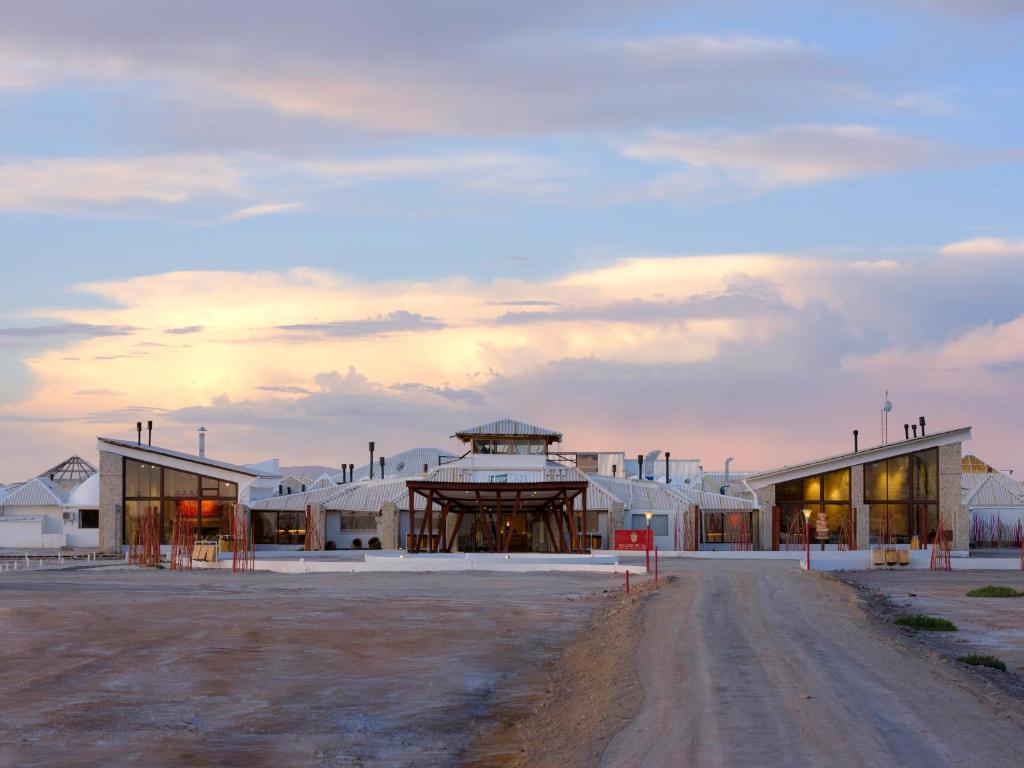
The real reason you come
As unusual as Palacio de Sal is, the hotel is really only half the story. You come here for the Salar de Uyuni.
Driving across it is difficult to properly describe because there is so little around you. You can travel for kilometres across an almost perfectly flat white surface, stop the vehicle and step outside into what genuinely feels like the middle of nowhere. There are no trees, buildings or roads to give the landscape any scale. In some areas, there is almost nothing at all between you and the horizon.
That complete lack of perspective is also responsible for some of the famously silly photos people take out here. Tiny people standing in someone’s hand, someone apparently being chased by a toy dinosaur, people climbing into wine bottles.
You can be a serious traveller again tomorrow.
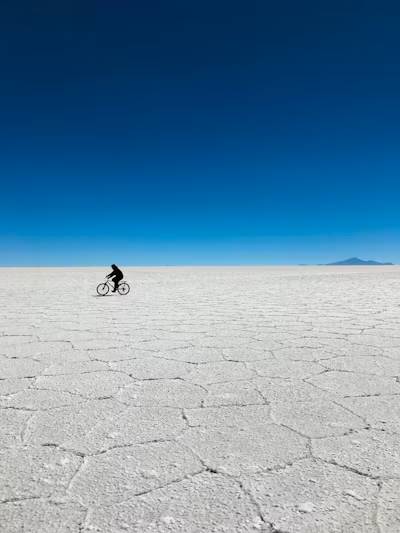
The landscape itself changes enormously depending on the time of year. During the dry season, the Salar is bright white and covered in huge geometric salt patterns that seem to run forever. The surface is harder and you get that classic endless white desert effect.
Then the rains arrive and everything changes.
When conditions are right, a shallow layer of water sits across the Salar and creates its famous mirror effect. Clouds, mountains and people are reflected beneath you, and suddenly the same landscape feels completely different.
We don’t think there is necessarily a better season to visit. They are almost two completely different versions of the same destination. Some people want that brilliant white salt desert and the enormous open landscapes, while others have the mirror effect firmly on the bucket list.
Either way, it is not subtle.
There is also much more to this region than simply driving onto the salt flat, taking a photo and driving back again. The wider Uyuni area is remote, high and wonderfully strange. There are volcanic landscapes, cactus-covered islands rising out of the salt, huge open spaces and scenery that can feel more like another planet than South America.
It is exactly the sort of place where we would spend a little longer rather than treating it as a quick fly-in, fly-out stop.
And then there is Bolivia
Bolivia often ends up sitting in the background when people start planning South America. Peru has Machu Picchu. Argentina has Buenos Aires and Patagonia. Brazil has Rio and the Amazon. Bolivia tends to be the country people know slightly less about, and that is probably part of why we find it so interesting.
You can spend time in La Paz, one of the world’s highest major cities, explore the markets and streets of the Altiplano, visit Lake Titicaca and then continue south into landscapes that become progressively bigger, emptier and more surreal until you eventually reach Uyuni.
And then you sleep in a hotel made from salt.
It is certainly not the easiest destination in South America, and we don’t think there is any point pretending otherwise. The altitude is something to take seriously, travel between places can take time, and some of the distances are huge. This is not somewhere you come for a quick, easy holiday where everything happens five minutes from your hotel. But that is also a big part of its appeal.
Bolivia still feels adventurous.
There are places here that still feel genuinely remote, where getting there is part of the experience and the landscapes don’t look quite like anywhere else you have travelled. Palacio de Sal fits into that perfectly.
A gimmick that gets away with it
A hotel made almost entirely from salt sounds like it should be a bit of a gimmick, but Palacio de Sal somehow gets away with it. The materials come from the Salar, local craftspeople continue to maintain and rebuild it, and the landscape outside is the reason the hotel exists in the first place.
You could stay somewhere far more conventional.
But after spending the day crossing the largest salt flat in the world, there is something rather fitting about coming back to a room where the walls, ceiling and bed base have all been built from the exact same landscape.
Just maybe don’t lick the walls.
We’ll handle the altitude, the distances and the timing
Mirror season or bright white salt, how to acclimatise on the way up, and how to link La Paz, Lake Titicaca and Uyuni without rushing. We’ll pace the journey so you arrive ready to enjoy it.